Solana (SOL) — Buy: From Meme Coins to Global Financial Infrastructure
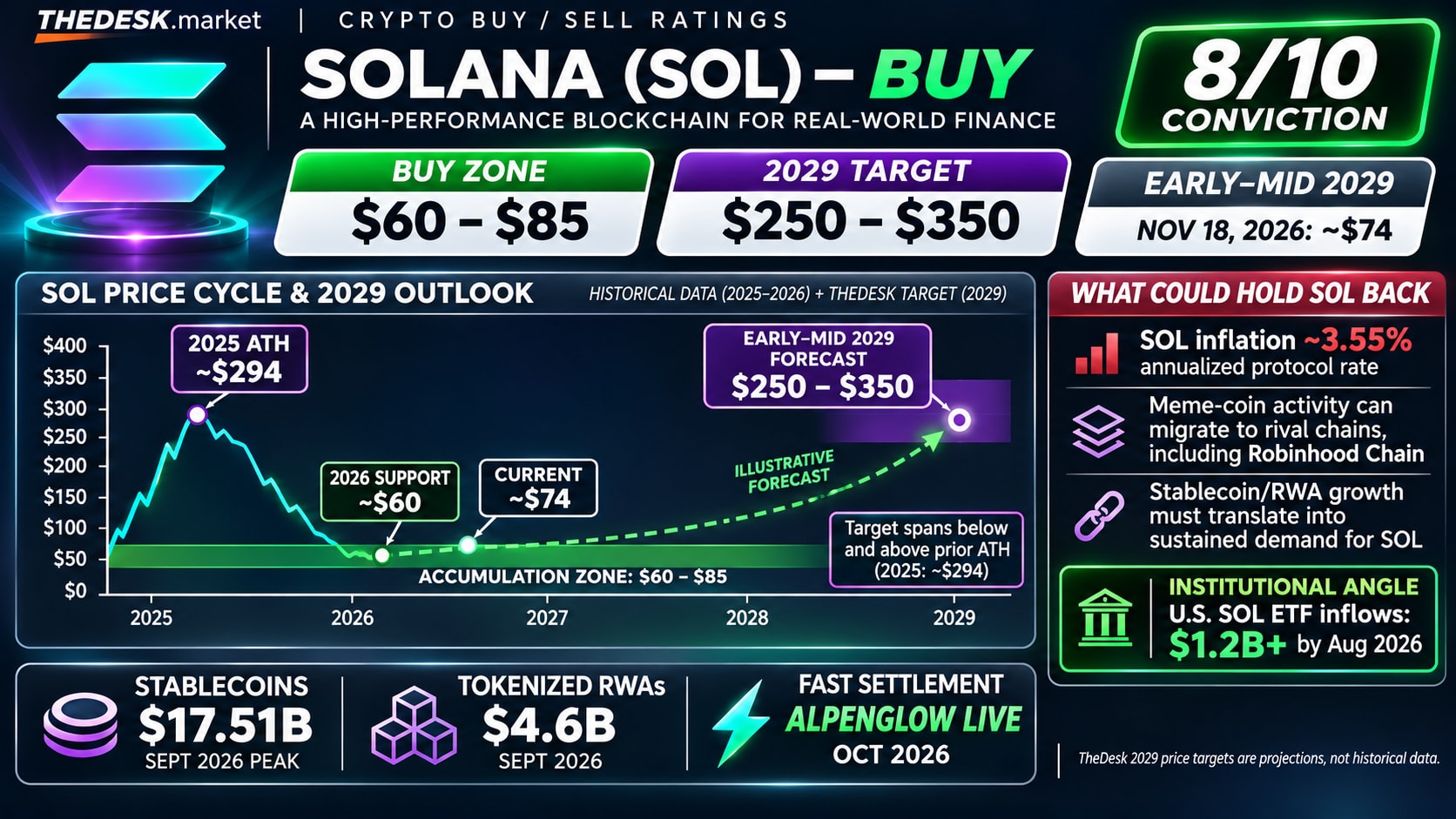
The Desk rates Solana Buy with 8/10 conviction, a $60–$85 accumulation zone, and a $250–$350 long-term target for early to mid-2029.
By The Desk Research · Published
- Rating
- Buy
- Conviction
- 8/10 — editorial confidence, not a probability or guarantee
- Buy zone
- $60–$85
- Long-term target
- $250–$350
- Target date
- Early to mid-2029
- Sell signal
- Reassess below $60
Investment Outlook
Solana has established itself as one of the largest blockchain networks in cryptocurrency, combining fast transactions, low fees and an ecosystem that has attracted substantial trading activity.
The network's earlier growth was closely associated with meme coins and speculative trading. The Desk believes its next major opportunity is to become a broader financial network for stablecoins, tokenized stocks and real-world assets.
The transition is underway. By September 2026, the supplied research reports a record $17.51 billion in stablecoin supply on Solana and approximately $4.6 billion in tokenized real-world assets. Tokenized-equity trading volume was approximately $4.4 billion during that month.
These figures point to an ecosystem extending beyond meme-coin speculation. The Desk rates SOL Buy with 8/10 conviction, preferring accumulation between $60 and $85 and setting a $250–$350 target for early to mid-2029.
Why $60–$85 Is Our Buy Zone
Solana reached a prior all-time high near $294 in January 2025 before a substantial correction during the subsequent market downturn. SOL later traded near $60 in June 2026, an important historical support reference in the supplied analysis.
The accompanying November 18, 2026 price snapshot places SOL near $74. Against that context, The Desk views $60–$85 as a preferred long-term accumulation range, rather than a claim about the live market price.
The range is roughly 71%–80% below the prior peak near $294. If the $250–$350 forecast is reached, the target would represent approximately 3x–5.8x the supplied $60–$85 entry range. Those are scenario comparisons, not promised returns.
A sustained move below $60 would weaken the technical part of the thesis and prompt a reassessment. The rating does not set a formal stop-loss or automatic sell order.
From Meme Coins to Financial Infrastructure
Solana's appeal to financial applications centers on speed, low transaction costs and the ability to handle frequent activity on one network. Its ecosystem includes tokenized stocks, Treasury products, lending markets, stablecoins, decentralized exchanges and institutional infrastructure.
The supplied September 2026 figures include about $4.4 billion in tokenized-equity trading volume and more than one million cumulative wallets holding tokenized stocks. Those activity metrics suggest demand beyond short-lived token speculation, although activity does not automatically translate into demand for SOL.
A potential institutional catalyst came on November 12, 2026, when the supplied research says DTCC announced plans to connect its tokenization service to Solana in the second half of 2027. The planned integration could make eligible traditionally held securities available in tokenized form.
The Desk views this as a potentially important development for the next market cycle. If traditional securities continue moving onto public blockchain networks, Solana could compete for part of that activity alongside Ethereum and other chains. The scale of any resulting SOL demand remains uncertain.
Stablecoins Could Become a Major Growth Driver
Stablecoins let businesses, institutions and individuals move digital dollars without relying exclusively on conventional banking rails. Solana is positioning itself as a high-speed settlement network for those transfers.
The supplied analysis cites more than $1.9 trillion in stablecoin settlement value on Solana during the first half of 2026, representing over 22% of global stablecoin transaction activity in the referenced industry research. By September, stablecoin supply on the network had reached $17.51 billion.
The Desk believes stablecoins and tokenized financial products could become more durable parts of Solana's investment thesis than meme-coin trading. AI-agent payments, decentralized markets, consumer applications and other services requiring frequent, low-cost settlement are additional possible growth areas.
Competition and the Meme-Coin Risk
Speculative trading remains one of Solana's important risks. Meme-coin capital is mobile, and competing networks can attract traders and liquidity when new applications or incentives emerge.
The supplied analysis describes Robinhood Chain as an emerging competitor during 2026. It cites Bitquery research showing the rival network's weekly meme-coin volume rising from approximately $1.4 billion to $3.5 billion in August, while Solana remained near $41 billion. Solana retained a substantial lead, but the comparison illustrates how quickly competition can grow.
The analysis also cites 21Shares research estimating Solana's gross network revenue fell about 87% in the first half of 2026 versus the same period in 2025, largely reflecting a decline from unusually profitable speculative activity.
If that activity continues shifting to other chains, Solana will need stronger demand from payments, tokenized assets, lending and institutional finance. The Desk believes that transition is possible, but it is not assured.
Inflation Keeps Conviction Below 10/10
Solana issues new SOL through staking rewards and has no fixed maximum token supply. Its inflation schedule began at 8% annually, with the rate designed to decline by 15% of itself each year toward a long-term floor of 1.5%.
The supplied November 18, 2026 snapshot puts protocol inflation near 3.55% annually, equivalent to roughly 3.36% supply growth over a year at observed network speeds. Staking rewards can help participating holders offset dilution; holders who do not stake may see their proportional share decline.
A proposal to accelerate disinflation gained support during 2026, but the supplied research says the faster schedule had not been activated as of November 18. Continued issuance means demand must grow enough to absorb additional supply, a meaningful disadvantage relative to more supply-constrained assets.
Network Upgrades and Institutional Adoption
Solana activated its Alpenglow consensus upgrade on October 21, 2026. The supplied material says the upgrade is designed to reduce transaction finality to approximately 150 milliseconds, strengthening the network's potential for payments, exchanges and tokenized markets.
Institutional interest is another part of the thesis. The research reports more than $1.2 billion in cumulative net inflows to U.S. spot Solana ETFs by August 2026. Continued ETF adoption, staking participation, financial integrations and new applications could support future growth.
These developments still need to translate into durable economic activity and demand for SOL. Transaction counts, partnerships or institutional access alone do not guarantee token-price appreciation.
Our $250–$350 Price Target for 2029
The Desk projects SOL could reach $250–$350 during the next major cryptocurrency bull market, anticipated in early to mid-2029. The range is more conservative than some forecasts circulating in the Solana community.
At $250, SOL would remain below its previous high near $294; at $350, it would exceed that reference by approximately 19%. The forecast assumes Solana keeps a leading position in decentralized trading while growing stablecoin, tokenized-securities and institutional-finance activity.
Using the supplied circulating-supply reference of approximately 592 million SOL, the target range implies a market capitalization of roughly $148 billion to $207 billion. The actual capitalization required in 2029 would be higher if supply continues expanding.
The Desk considers those valuations achievable in a favorable market cycle if Solana sustains ecosystem growth and captures a meaningful share of tokenized finance. Faster institutional adoption could support the upper end; weaker trading activity, persistent inflation or lost market share could limit a recovery.
The Bottom Line
Solana combines a large blockchain ecosystem, substantial trading liquidity, fast settlement and growing activity in stablecoins and tokenized financial products. That expansion gives it a credible path to becoming a major financial network alongside Ethereum.
The risks are continued token inflation, competition from Robinhood Chain and other networks, and a prolonged slowdown in speculative trading. The Desk believes the long-term opportunity outweighs those risks at the preferred $60–$85 accumulation range, but they keep conviction at 8/10.
The Desk Rating: BUY — 8/10 Conviction. The long-term price target is $250–$350 for early to mid-2029. These are editorial forecasts, not guarantees of future performance.
Key risks
- A sustained break below $60 would weaken the technical case and require review of the accumulation thesis.
- SOL issuance and staking rewards can dilute holders who do not stake; Solana has no fixed maximum supply.
- Meme-coin activity can migrate to competing networks, reducing a source of trading and network revenue.
- Stablecoin, tokenized-asset and institutional adoption may not translate into proportional demand for SOL.
- Crypto market conditions, regulation, liquidity, network performance or competition could materially change the outlook.
What would change our view
- Reassess if SOL sustains a decline below the $60 support reference or if the $60–$85 accumulation thesis no longer holds.
- Review the forecast if token inflation, network revenue or user activity diverges materially from the assumptions in the supplied research.
- Revisit the institutional-finance thesis if the planned DTCC connection, ETF adoption or tokenized-asset activity materially changes.
SOL creators & analysts to follow
Independent third-party commentary. The Desk does not endorse individual creators or their views.
YouTube
X
Rating history
- — Buy, 8/10. Initial coverage. Buy zone $60–$85; target $250–$350 for early to mid-2029.
Editorial opinion, not personalised investment advice. Price targets are forecasts and may not be reached.